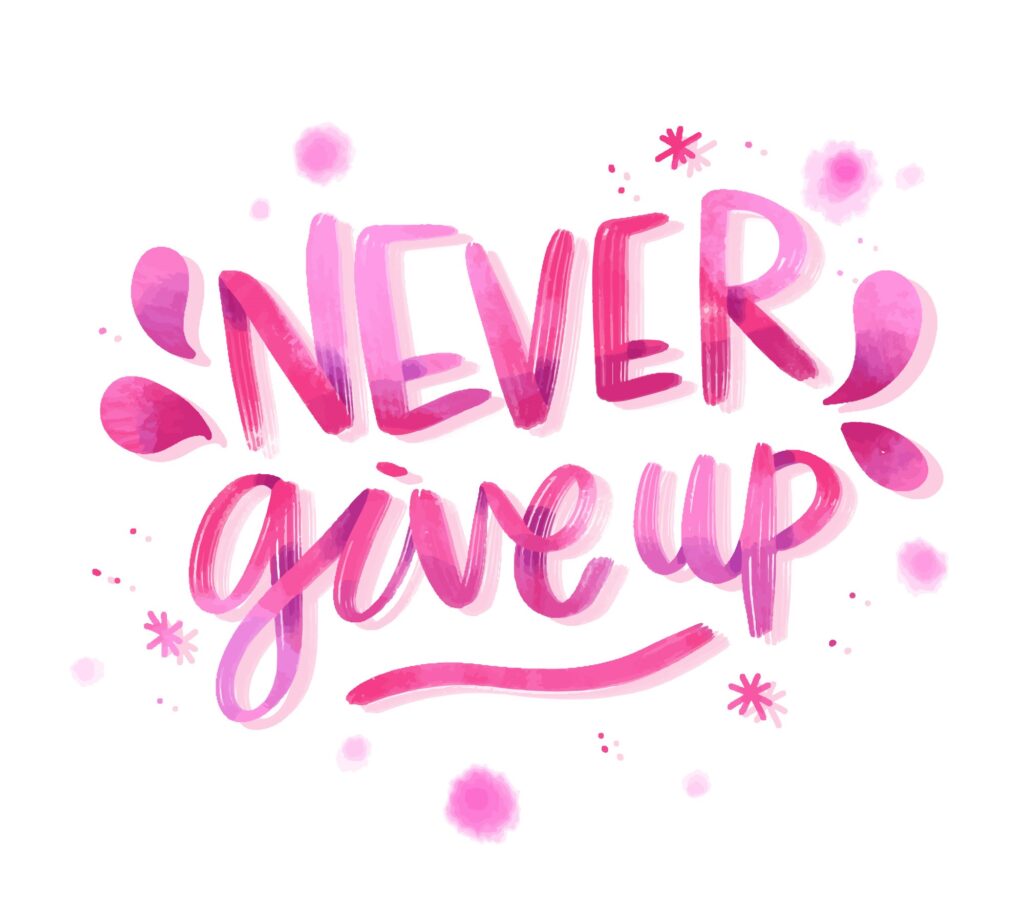
NEVER, NEVER, NEVER GIVE UP
As another school year draws to a close and the festive season approaches, people around the world begin putting up trees, lights, and decorations. One is reminded of the words: Christmas is a season not only of rejoicing but also of reflection.
Reflection is powerful. It helps each of us identify our strengths and weaknesses. Each learner receives a report that reflects his or her year’s work. Some open it with high expectations, confident that their hard work has been rewarded with excellent results, while others feel regret, thinking, “If only I had put in a little more effort.” And then there are those who open their reports with a sinking feeling, wanting to give up.
It is so important for every child to understand that each test, every project, every early morning and late night was a step towards growth. Excellent results don’t always reflect growth, and disappointing results don’t always reflect failure. As the children reflect on their year, may they know that no matter how hard the road may seem, perseverance is the key to unlocking potential. The next chapter will bring new opportunities and new challenges. Remember the words of Winston Churchill, Never, never, never give up.
Foundation Phase Head, Ms M Joosten

WHAT DID YOU LEARN AT SCHOOL TODAY?
It’s a question almost every family with school-going children has asked: ‘What did you learn at school today?’ When children come home, they should be able to share what they learned, whether it’s in Maths, Science, English or Geography.
Family members—parents, aunts, uncles, cousins, or siblings—can inspire a love of learning just by asking this question that shows they expect the child to have learned something new.
When children say things like ‘school is boring,’ or ‘I don’t like History,’ these attitudes can be gently discouraged by asking ‘What did you learn at school today?’ Such questions can spark a journey of discovery. That question can lead to others like ‘Why do you think that?’ and ‘What more can you find out?’ These types of questions give school a deeper purpose—they help children see that learning isn’t just about attending class but about enriching their minds and developing their thinking. When they know they’ll have an interesting discussion at home, they can approach school with curiosity and engagement.
This is what it means when a child ‘takes responsibility for his learning’. He is an active participant in class. He pays attention. He asks questions. He joins discussions. He goes beyond the basics by doing extra reading on the topic. He studies to learn the information, not to get good marks. He does his best on all the homework and assignments. He does a good job. He learns from mistakes. He seeks help. He doesn’t give up if something is difficult. He is respectful of his classmates and teachers and contributes to a positive learning environment.
“You can’t overload your brain.” Dr Ben Carson
Intermediate Phase Head, Mrs E Gouws

PARENTAL FEAR OF MISSING OUT
The familiar saying “keeping up with the Joneses” captures a long-standing urge to mirror the lifestyles of those around us. Today, this mindset often appears in discussions of the Fear of Missing Out (FOMO). In the context of parenting, FOMO is commonly understood as an anxiety that pushes parents to shower their children with experiences, activities and possessions in an attempt to prevent them from feeling left out.
This tendency often shows up in overspending—especially around holidays—when parents feel pressured to buy whatever is fashionable: the latest clothes, expensive trips or trendy stationery. Although these purchases can create an image of social relevance, they raise important questions. Do children learn to value what they have? Do they gain financial awareness? And, most importantly, do they develop a sense of identity that is real rather than shaped by passing trends? Genuine authenticity grows out of grounded values and thoughtful guidance, not a cycle of consumer expectations.
Educational choices can also be affected by parental FOMO. Some parents may push their children toward subjects or career paths regarded as prestigious in their community, even if these areas don’t align with the child’s gifts or interests. Such pressure can distort a young person’s sense of who they are and what they are capable of becoming. Authentic identity is not something performed to satisfy social norms—it arises from within. For that reason, parents are wise to prioritise their child’s individuality rather than the standards set by others.
Ultimately, identity rooted in something greater than shifting social pressures provides real stability. For Christians, grounding one’s identity in Jesus Christ offers direction and reassurance. His eternal nature anchors personal worth and guides both parents and children toward values that outlast temporary cultural expectations, helping them build lives shaped by principles that endure.
Senior Phase Head, Mrs N Ngubane
Sources: https://en.wikipedia.org/wiki/Keeping_up_with_the_Joneses
https://www.helpguide.org/mental-health/wellbeing/fear-of-missing-out-fomo
https://st.network/analysis/top/identity-crisis-a-short-guide-for-parents-of-teenagers.html

CHANGE THE WORLD
There are many success stories throughout history that continue to inspire us – Helen Keller, Albert Einstein, Marie Curie, Eric Liddell… We admire these individuals because they achieved greatness in their respective fields. Why do we look up to them? Because within each of us lies a desire to succeed, whether the task is great or small.
In the professional world, success often means climbing the ladder of promotion. In business, it is about maximising profit. The same principle applies in education, where success is most often measured by academic performance. While some learners may excel in sports to become world champions, academic achievement remains the benchmark of success in schools. “Academics come first” – is a sentiment that echoed by most educators. Schools aim for 100% pass rates, celebrate distinctions and top achievers and showcase these accomplishments in marketing materials and local newspapers. Teachers, especially those teaching final-year learners, often feel significant pressure to deliver results.
Fortunately, the business world has developed over the past few decades, moving away from measuring success solely by financial performance. Frameworks like King IV and ESG (Environmental, Social, and Governance) reporting have introduced legal obligations for companies to look beyond the bottom line and to give attention to that which matters to us all: society and the environment. Today, success is not just about profit, but also about people and the planet. While some initiatives may be superficial – commonly referred to as greenwashing – there are genuine efforts that extend beyond corporate profit to make a meaningful difference.
In 2025, Domino Servite School continued to pursue academic excellence, a core value entrenched in its Mission Statement. We remain committed to a 100% pass rate, striving to support every learner in reaching their full academic potential. Yet, although not required by legislation, nor by a company Act, DSS has expanded its vision to embrace the principles of the triple bottom line.
In an outreach to neighbouring communities, each grade from 7 to 12 adopted an Early Childhood Development (ECD) centre, aiming to uplift and improve these facilities. Learners repaired jungle gyms, repainted classrooms, planted and fenced vegetable gardens, and spent time playing with and entertaining the young children. On the environmental front, learners were educated about recycling and the importance of tree planting. Each grade was also assigned a garden patch to cultivate vegetables. Today, the school manages over a thousand square metres of land, producing beetroot, lettuce, cabbage, and other vegetables for the local community.
Indeed, Domino Servite School has embraced the principle of responsible citizenship, as stated in its Mission Statement – making a tangible impact on the lives of others while remaining steadfast in its commitment to academic excellence. We look forward to continuing this journey of meaningful change, because if you change the world for one person, you have changed the world – for that one person.
Head of FET Phase, Mr D van Straten

HANDWRITING ISN’T AN OLD-FASHIONED SKILL
In our technology-driven world, it’s easy to assume that handwriting no longer matters. Yet research continues to prove that writing by hand is vital for children’s learning and development. Far from being outdated, handwriting engages multiple senses—sight, sound, and touch—and activates several areas of the brain at once. This rich sensory experience strengthens memory, boosts reading skills, and builds the foundation for confident, fluent writing.
When children learn to form letters by hand, they are doing more than just practising neatness. The physical act of shaping each letter helps them remember it better, which accelerates reading and spelling development. Once handwriting becomes automatic, their minds are freed to focus on expressing ideas, structuring sentences, and communicating clearly. Studies even show that university students who take notes by hand recall information more effectively than those who type, as handwriting requires the brain to think, summarise, and make connections.
Effective handwriting instruction involves direct teaching, clear modelling, guided practice, and immediate feedback. It should be woven naturally into all school subjects—from writing numbers in maths to labelling diagrams in science. Making handwriting a daily habit reinforces its importance and supports literacy across the curriculum.
For younger children, readiness is key. Activities that build fine and gross motor skills—like playing with clay, drawing in sand, or using chalk—prepare the hands and brain for fluent writing. For learners with difficulties such as dyslexia or dysgraphia, cursive writing can be especially helpful. Its continuous motion reduces letter reversals, supports rhythm and fluency, and boosts confidence.
Ultimately, handwriting remains a powerful educational tool. By prioritising structured handwriting instruction in the early years, schools give children the keys to stronger reading, clearer thinking, and lifelong learning success.
Academic Head, Mrs G Geldenhuys